
![[Group News] Leaders from Gansu Mobile Paid a Visit for Exchange and Guidance](/d/file/efpub/20250919/5e3579e7820f5f53c8128cbf6290f358.jpg)
Good News!
GXF273 Non-Jumper Optical Cable Cross-Connect Cabinet Won One of the Top 100 Shanghai High-tech Achievement Transformation Projects in 2018
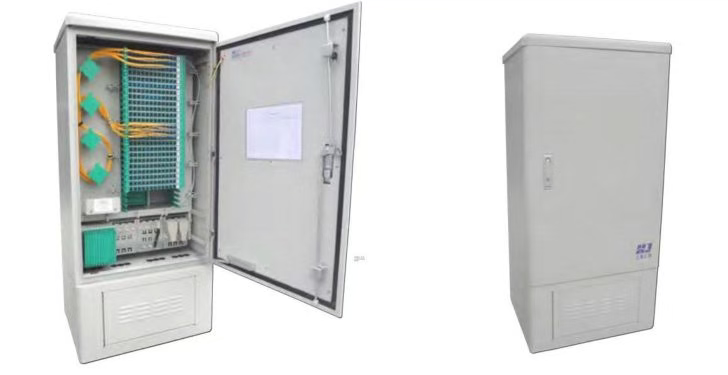
Overview of Optical Cable Cross-Connect Cabinets
An optical cable cross-connect cabinet is a device for outdoor optical fiber distribution at the node of trunk optical cables and distribution optical cables in the outdoor optical cable access network. Composed of the cabinet body, internal structural parts, optical fiber movable connectors, and accessories, it can realize the functions of optical fiber through connection, storage, fusion splicing, and scheduling.
Definition of Non-Jumper
A non-jumper optical cable cross-connect cabinet is a convergence point in the FTTX access network. The distribution optical cable (user-side optical cable) in the cabinet is directly terminated with pigtails (without termination), and the pigtails can be directly connected to the optical splitter ports or the flanges of the office-side optical cable termination; or the optical splitter side is directly terminated with pigtails, and the pigtails can be directly connected to the flanges of the user-side optical cable termination.
It reduces the loss of one live connector in the optical path, eliminates optical jumpers to form a non-jumper optical cable cross-connect device, saves optical power, and reduces faults caused by damage to adapters and jumpers.
Advantages of Non-Jumper Optical Cable Cross-Connect Cabinets
Cost Saving
Due to the use of optical splitters, the distribution capacity is doubled, which can save about 50% of the investment cost.
Reduced Fault Links
Each line reduces one jumper and one adapter, eliminating one movable connection point, which can effectively reduce fault links and lower operation and maintenance costs.
Reduced Optical Power Loss
Each optical fiber path can effectively reduce 1-2 adapter connections, which can reduce the optical attenuation loss by 0.5dB, and extend the terminal coverage distance by 1 kilometer (calculated at 0.4DB/KM).
——END——